Jewitt Arschavir & Wilkie Architects, Glasgow City Centre Project Proposal Design
308 Clyde St Property
Clyde Street building design by JA&W Architects, Scotland
post updated 28 February 2025
Location: adjacent to the former Customs House, city centre, nort bank of the River Clyde.
Type: housing – with commercial use on basement and ground floors.
Design Statement : Jewitt Arschavir & Wilkie Architects, Glasgow
Clyde Street Property
Location
Located in the heart of Glasgow City Centre overlooking the River Clyde, the site forms an infill between the back-packers Euro Hostel and the former Customs House on Clyde Street. The development forms and interface between the Hostel and Custom House thus reinforcing the gateway into the city from the South of the River Clyde with good views afforded from Thomas Telford’s Jamaica Bridge and the main railway bridge to Central Station Glasgow.
The Design
The development comprises 12 storeys in total with the Basement and Ground floors devoted to commercial use – let as one large or 2 smaller units Over the next 2 floors there is a floor plate comprising of 3 one bed flats each. The next 7 floors comprise 2 two bed flats, with the layout of each flat designed to offer maximum flexibility allowing it to be used as an open plan loft style apartment or a more conventional 2 bedroom flat.
The top two floors comprise 2 prestige duplex flats, which incorporate extensive glazing, balconies, and terracing designed to maximise the panoramic views over the city and the river. The planning of the flats has been carefully considered to take full advantage of their orientation. Externally the three stories at street level are treated in a uniform background of Sandstone to correspond with the Listed Custom House adjacent. A steel and glass canopy that runs the length of the facade signalling the entrance to the residential part of the building and unifying the entrances to the commercial uses at the lower level.
The asymmetrical white masonry pre-cast element and blue/grey terracotta tiles frame and unify the 7 residential floors above. The use of a light coloured masonry provides a visual lift to the immediate area The terracotta tiles wrap around the corners to the East and West. A random arrangement of glazing adds interest and enhances the individuality of these flats. The uppermost two floors are predominantly transparent. They are set back from the main building line. This further reduces the impact on Clyde Street and allows for the introduction of balconies & roof gardens.
Conclusion
Great care has been taken in the design of this building to achieve a mixed use development which will return vitality to this prominent corner of Glasgow’s centre and generate revenue for the city whilst at the same time ensuring that the setting of Custom House is protected. Urban vistas are maintained or improved and the city skyline is not adversely affected. It also acts as a vehicle for modern design to reflect the resurrection of the City as a desirable residential location.
Jewitt Arschavir & Wilkie Architects : Building information 8 Apr 2003
Further along Clyde St is the Icon building (below) and proposed Custom House Quay
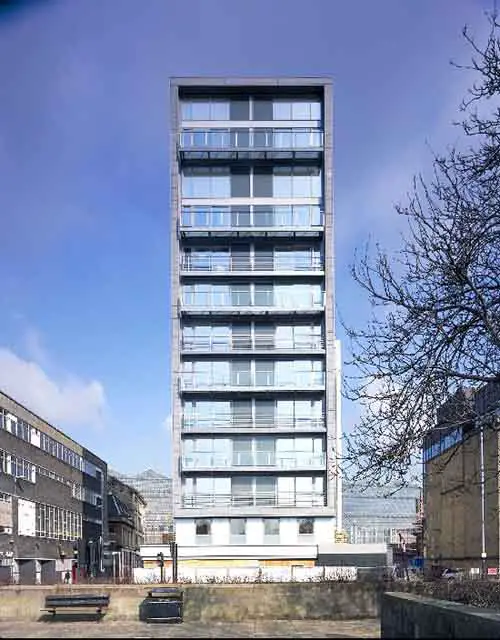
image © Keith Hunter
Glasgow Buildings
Buildings / Developments close by – key selection below:
+++
Glasgow Housing Designs
Contemporary Glasgow Residential Property Designs – selection:
The Foundry Cathcart housing development
Buildings / photos for the Clyde Street Glasgow building design by JA&W Architects page welcome.